


A fence that looks tidy in August can be a sagging apology by February, and the culprit is rarely the netting itself. It is almost always the strainers, the depth of the line posts and how much tension went in on the day it was built.
Stock fencing rewards patience at the start. Get the corners right, keep the wire tight and match the mesh to the animals, and a well-built fence will hold sheep and cattle for years with very little attention. Here is how to approach it if you are fencing a smallholding for the first time.
Before you drive a single post
Walk the whole line first, ideally with a tape and a notebook. Mark the corners, the gate openings, any trough or tree that will sit inside or outside the fence, and any stretch where the ground turns to rock or bog. Moving a fence line on paper costs nothing. Moving it once the posts are in costs a weekend.
Decide what the fence is actually for. Sheep need small mesh and a fence that reaches the ground. Cattle need height, strength and something that will take a shoulder leaning against it. If you run both, you are building to the sheep specification and adding height for the cattle.
If you are fencing a boundary rather than an internal division, check whose responsibility it is — boundary fencing is often the responsibility of one side only, and that is usually recorded in the deeds. Where a hedgerow would need removing, the local authority normally has to be consulted first. If a public right of way crosses the land, gates and stiles must stay usable. Where any of that is unclear, take proper advice before starting.
Strainers: the corners that carry the load
Every corner, end, gatepost and change of direction needs a strainer. On a long straight run, add one roughly every 100 metres, because a single bay of strained netting can only hold so much before it starts pulling posts out of line.
Depth matters more than bulk. A useful rule of thumb is to bury a quarter to a third of the post length. A 2.4-metre strainer therefore wants at least 700mm in the ground, and more in sandy or peaty soil. Ram the backfill in shallow layers with a crowbar or a length of scaffolder rather than tipping it all in at once.
Brace every strainer with a diagonal bar from near the top down to the foot of the next post, notched into the strainer so it cannot slide. A box brace, with two diagonals and a horizontal bar, is stronger again and worth the extra timber at a gateway where stock will crowd.
Setting a strainer in four steps
- Dig the hole to depth, keeping it as narrow as the post allows.
- Stand the post, check it plumb on two faces with a spirit level, and wedge it roughly in place.
- Notch and fit the brace, pinning or bolting it so it sits tight against the strainer.
- Ram the backfill in 100mm layers, checking the level again as you go.
Line posts: depth beats diameter
For sheep netting, three metres between line posts is the standard. On undulating ground pull it in to 2.5 metres, so the netting follows the contours without gaping along the bottom. Cattle-only fences can run to three or four metres on flat ground, though tighter spacing always gives a longer-lasting fence.
Drive intermediate posts at least 450mm into the ground, and 600mm in soft ground or where cattle will rub. On a slope, the strained netting pushes downhill, so posts on a gradient need to go deeper than those on the flat.
Tanalised softwood, chestnut, recycled plastic and coated steel posts all have their place. Steel posts are quick to drive and easy to reposition, but they need a driver and a clear line. Timber is more forgiving and easier to staple.
Choosing netting for sheep and cattle
Netting heights are not a matter of taste. Buy to suit the stock, and buy the best knot you can afford — a hinge-joint netting holds its shape and takes staples far better than a light woven mesh.
- Sheep only: 800–900mm netting, with the smallest mesh at the bottom where lambs will nose through.
- Cattle only: 1050–1200mm netting, or fewer horizontal wires spaced wider.
- Mixed grazing: 1050–1200mm netting, with a single strand of plain high-tensile wire above it.
- Heavy rubbing: an offset electric strand is often more effective than barbed wire, and kinder to wool.
Keep the bottom wire close to the ground. A gap of a few inches at the base is where ewes push through and where rabbits start work.
Tensioning the wire
Unroll the netting along the line and stand it up rather than dragging it. Tie off at one end strainer, then work along with a proper wire strainer, pulling in stages rather than all at once. Hauling a long run tight in one go puts a huge load on the far strainer and can snap wire or drag a post sideways.
Judge the tension by feel. Press the middle of a bay with a flat hand: it should give a couple of centimetres and spring back. Wire contracts in cold weather, so a fence that is drum-tight in January may slacken by July. Slightly under-tensioned and re-tightened in spring is better than over-tensioned and pulling strainers out of the ground.
Staple after tensioning, not before. Use two staples per post, staggered — one vertical, one horizontal — and leave a fraction of room so the wire can still move. Never drive a staple flush home; you will cut into the wire and it will fail in exactly that spot.
Gates, slopes and awkward ground
Gateposts take a hammering, so set them as strainers and brace them properly. Hang the gate so it swings away from the brace rather than into it, and keep the gap beneath it tight — sheep will find a 150mm gap and make it their own.
On a slope, run the netting with the ground rather than stepping it, unless the gradient is steep enough that stock could push underneath. Put an extra strainer at the brow and the foot of a steep pitch, where the load builds up.
Where you hit rock, dig what you can and consider a steel post driven with a rock spike, or shorten the spacing and accept a slightly shallower set. A post that will not go in fully is still better than a hole in the fence line.
After the first winter
Walk the fence a week after building, again after the first hard frost, and once more at the end of winter. That is when the faults show up: a strainer that has shifted, staples that have pulled, a bay that has slackened, a bottom wire that has lifted.
Carry a hammer, a handful of staples and a spare coil of wire with you, and fix small problems while they are still small. Keep a few spare posts in the shed — the day you need one is never the day you want to go to the merchant.
Finally, look along the line as your stock sees it. Fold any cut wire ends back on themselves, keep barbed wire well above sheep height, and check regularly for anything sharp or loose. A fence that is safe, tight and checked twice a year is the cheapest livestock equipment you will ever own.
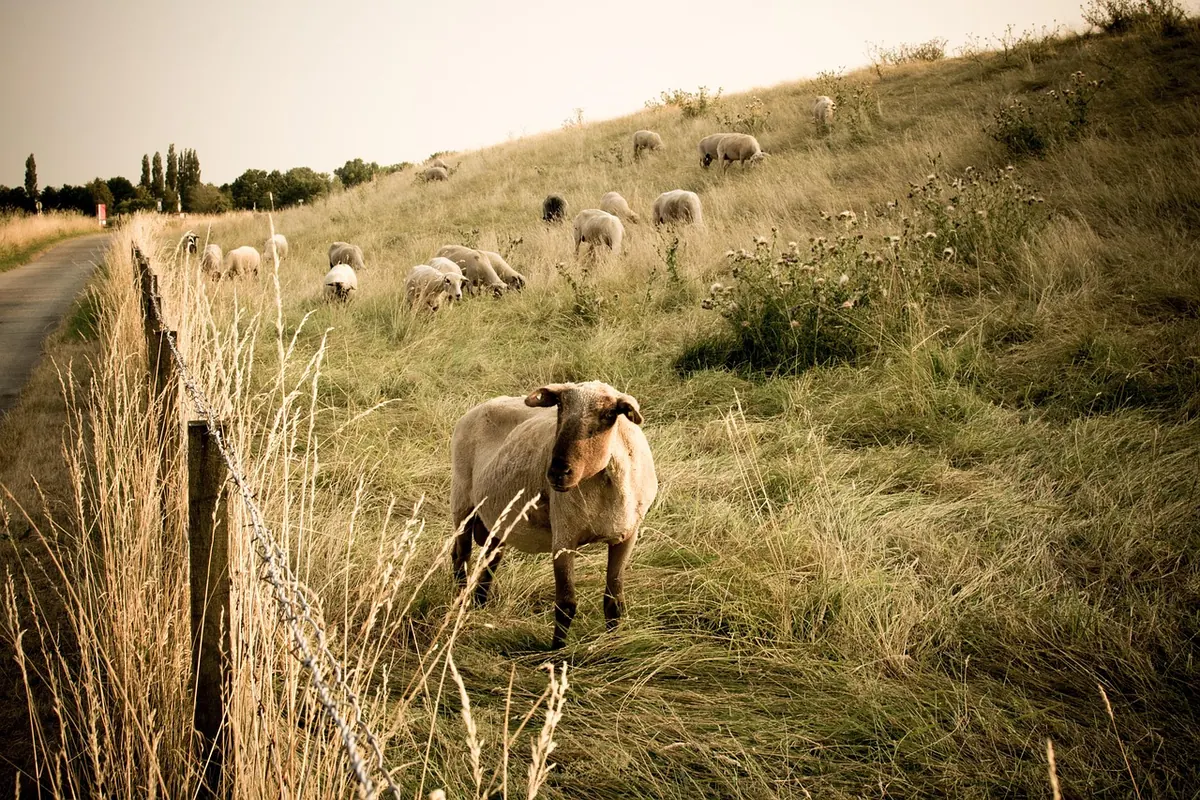
Photo: ThorstenF / Pixabay