


A fence rarely fails all at once. It fails because a corner post went in a metre short of the corner, or the netting was chosen for its height rather than for the stock, or a gateway ended up in the hollow that holds water from October to March. None of those decisions feels expensive at the time. Together they turn a fifteen-year fence into a five-year one, and the rebuild costs more than the first job because you are paying to take the old one out.
Most of the mistakes below are made before a single staple is driven.
Strainers in the Wrong Place, or Too Small for the Job
Strainers carry the load of the whole run. Every corner, gateway, end and change of direction needs one, braced against the direction the wire actually pulls. The classic error is setting a strainer where it is convenient to dig rather than where the load lands, then hoping a heavier post will cover for it.
Depth matters more than diameter, but you need both. A strainer belongs in firm subsoil, not the soft layer that shrinks in a dry summer. As a rough guide, a third of the post goes into the ground, and more in light or wet soil. If the ground will not hold a post, move the strainer or bury a deadman across it rather than fighting the site.
Bracing is not optional
A strainer with no strut and brace wire is a post under pressure. The strut runs down the line of pull, from the top of the strainer to the base of the next post; the brace wire ties the two together and passes the load into the ground. Fit the whole assembly before you tension anything, because wire pulled against an unfinished brace simply drags the strainer over.
On long straight runs, plan a mid-line strainer. It stops the line sagging in the middle.
Choosing Netting by Price Instead of by Stock
Netting is where the quiet losses hide, because the wrong roll still looks like a fence once it is up.
- Match the mesh to the smallest animal. A lamb goes through a gap the size of its head, so sheep netting needs a tighter bottom section. Decide what will be behind the fence in five years, not just this spring.
- Hinge joint or fixed knot? Hinge-joint netting flexes with impact, which suits sheep on uneven ground. Fixed-knot netting holds its shape over long runs and suits heavier stock.
- Look at the coating, not just the gauge. Two rolls can be the same height and wire thickness and last very different lengths of time. Heavier galvanising is the difference between rusting at twenty years and rusting at ten.
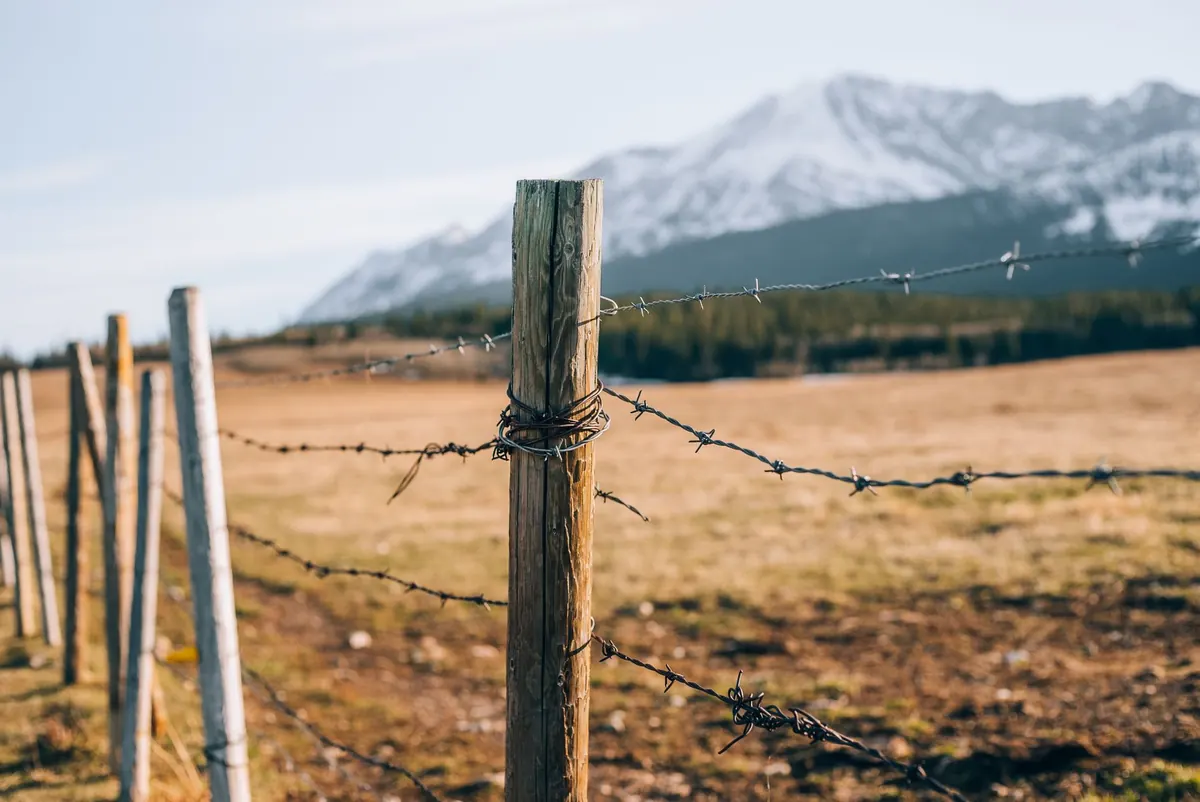
- Barbed wire has no place where horses are turned out. It is a poor top wire on a sheep fence too, where animals push underneath and catch themselves above.
Spacings That Let Stock Straight Through
Saving six posts across a field is a false economy you pay for twice. On level ground with standard stock netting, line posts at roughly three-metre centres is a sensible starting point. Tighten that where the ground is soft, where the fence climbs or drops steeply, and anywhere stock crowd.
The crowding points are the same on every farm: gateways, troughs, feed rings and the inside of every corner. Put extra posts there, and consider a rail or a heavier wire. The middle of a long straight run needs none of that, which is exactly where people tend to add posts just in case.
Depth follows the same logic. Bury roughly a third of the post, deeper in sand or peat, and check it is upright before moving on. A post leaning slightly today is a post leaning badly after two wet winters.
Tensioning and Stapling Errors
Both extremes cost you. Slack wire sags, rubs and lets a heifer reach over for the hedge. Over-tensioned wire pulls strainers out of line, cuts into itself at staples and contracts sharply in cold weather, which is when the weak points find you.
Use a tension gauge and follow the figures published for the wire you actually bought; they vary enough that guessing is pointless. Tension in stages along the run rather than all at once from one end, then walk it back a week later.
Staples do more damage than people expect. Drive them so the wire can still move slightly inside them — a staple hammered hard onto the wire pinches it and creates the stress point that snaps in a gale. Set staples across the grain rather than along it. Where a proper knot, clamp or gripple is what the wire needs, use one, and leave no sharp tails at eye height.
Line, Ground and Gateways
Run the fence straight between strainers rather than following every bump in the ground. A fence that rises and falls with the surface never tensions evenly, and the high spots take all the strain.
Gateways deserve more thought than they usually get. Put them on firm, level ground rather than in the hollow that floods, and make them wide enough for the widest thing you will ever take through. Hang the gate so it swings away from the fence line and into open ground, and put down a hardcore apron so the area does not turn into a bog.
Clear a strip either side before you start. Vegetation against wire keeps it damp and shortens the life of the coating.
Electric Fencing: Small Faults, No Shock
Most electric fence problems come down to earthing and insulation. Use enough earth rods driven into damp soil, and keep the earth system clear of galvanised posts and other metalwork. Size the energiser for the length of run and the amount of grass touching the wire. Use proper insulators instead of baler twine, and keep live wire clear of hedges and old wire fences.
Buy a fence tester and walk the line after rain. Faults found early cost minutes; faults found when stock are out cost a morning and a vet bill.
Doing It Once, Properly
Spend your money at the strainers and on the coating. Those two choices decide how long the fence lasts; the rest is labour. Write down what you buried and where — a simple sketch of the run, with strainers and any buried pipe or cable marked, will save somebody hours later.
Then treat the fence as something to look at. Walk it after storms, after moving stock and after harvest machinery has been through. Tighten what has slackened, replace what has broken, cut back anything growing into the line.
If the fence marks a boundary, establish whose responsibility it is before you spend anything on materials. Boundary fencing is a common source of dispute, and it is worth taking proper advice rather than assuming. For larger jobs, a day of a specialist's time to set out the strainers can save weeks of redoing your own work.
Photo: Josh Hild / Pexels